Helical Gears
Helical gears are similar to power screws in that there are now two angles that will impact the direction of force.Helical gears are similar to spur gears but have teeth inclined at a helix angle \( \psi \). This results in smoother engagement and quieter operation. However, the angled teeth introduce axial forces in addition to tangential and radial forces. Where \( \phi_n \) is the normal pressure angle and \( \psi \) is the helix angle. Helical gears experience similar bending fatigue as spur gears, but stresses are calculated using modified geometry factors to account for angled teeth and load sharing across multiple teeth. The gear ratio is given by:
.svg)
The relationship between normal and transverse pressure angles is:
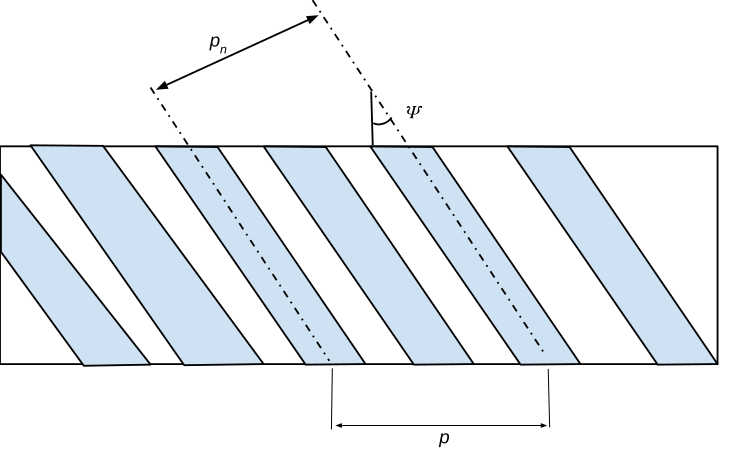
The pitch diameter of a helical gear is:
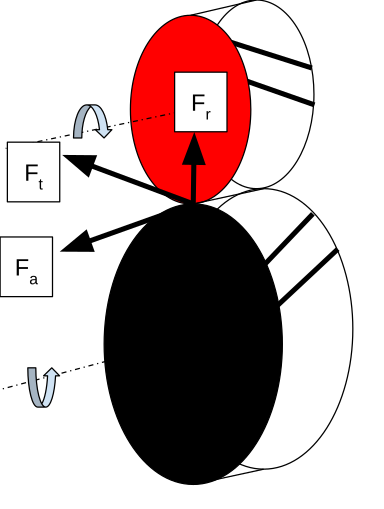
The force components include axial and radial forces:
| Variable | Description | Typical SI Units | Typical Imperial Units |
|---|---|---|---|
| \( \omega \) | Angular velocity | rad/s | rpm |
| \( N \) | Number of teeth | - | - |
| \( d \) | Pitch diameter | m | in |
| \( P \) | Diametral pitch | teeth/m | teeth/in |
| \( P_n \) | Normal diametral pitch | teeth/m | teeth/in |
| \( \phi \) | Pressure angle | degrees | degrees |
| \( \phi_n \) | Normal pressure angle | degrees | degrees |
| \( \psi \) | Helix angle | degrees | degrees |
| \( F_t \) | Tangential force | N | lb |
| \( F_r \) | Radial force | N | lb |
| \( F_a \) | Axial force | N | lb |
A more refined bending stress model used in gear design is given by the AGMA equation, which accounts for geometry and real-world loading effects such as dynamic forces, overload, and misalignment:
| Variable | Description | Typical SI Units | Typical Imperial Units |
|---|---|---|---|
| \( \sigma \) | Bending stress | Pa | psi |
| \( F_t \) | Tangential force (transmits power) | N | lb |
| \( P \) | Diametral pitch | teeth/m | teeth/in |
| \( b \) | Face width | m | in |
| \( J \) | Geometry factor (includes stress concentration) | - | - |
| \( K_v \) | Dynamic (velocity) factor | - | - |
| \( K_o \) | Overload factor | - | - |
| \( K_m \) | Mounting factor (alignment effects) | - | - |
Bevel Gears
Bevel gears are based on rolling cones rather than rolling cylinders, meaning they transmit motion between intersecting shafts (typically at \( 90^\circ \)). Because of this geometry, the pitch diameter varies along the tooth, and an average pitch diameter is used for analysis.
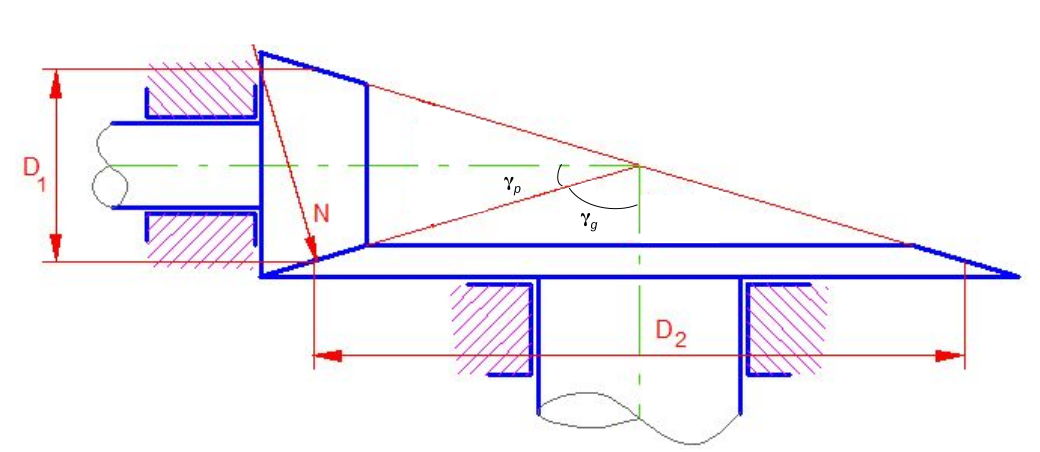
The geometry is defined by pitch cone angles \( \gamma_p \) (pinion) and \( \gamma_g \) (gear), which satisfy:
The speed (gear) ratio can be expressed as:
An average pitch diameter is used for velocity calculations:
The contact force acts along the line of action and can be resolved into tangential and normal components:
The normal force further resolves into radial and axial components:
| Variable | Description | Typical SI Units | Typical Imperial Units |
|---|---|---|---|
| \( F_t \) | Tangential force (transmits power) | N | lb |
| \( F_r \) | Radial force (separates gears) | N | lb |
| \( F_a \) | Axial force (acts along shaft) | N | lb |
| \( \phi \) | Pressure angle | degrees | degrees |
| \( \gamma \) | Pitch cone angle | degrees | degrees |