Axial Loading
Stress Tensor from Pure Axial Loading
For a scenario with only axial loading conditions, the stress tensor can be simplified as shown below.
Saint-Venant's Principle: Slender Beam Case
.jpg)
Stress analysis very near to the point of application of load \( P \). Saint-Venant's principle: the stress and strain produced at points in a body sufficiently removed* from the region of external load application will be the same as the stress and strain produced by any other applied external loading that has the same statically equivalent resultant and is applied to the body within the same region.
*farther than the widest dimension of the cross sectionHeads up!
Stress concentration factors build on this content in engineering materials and machine failure.
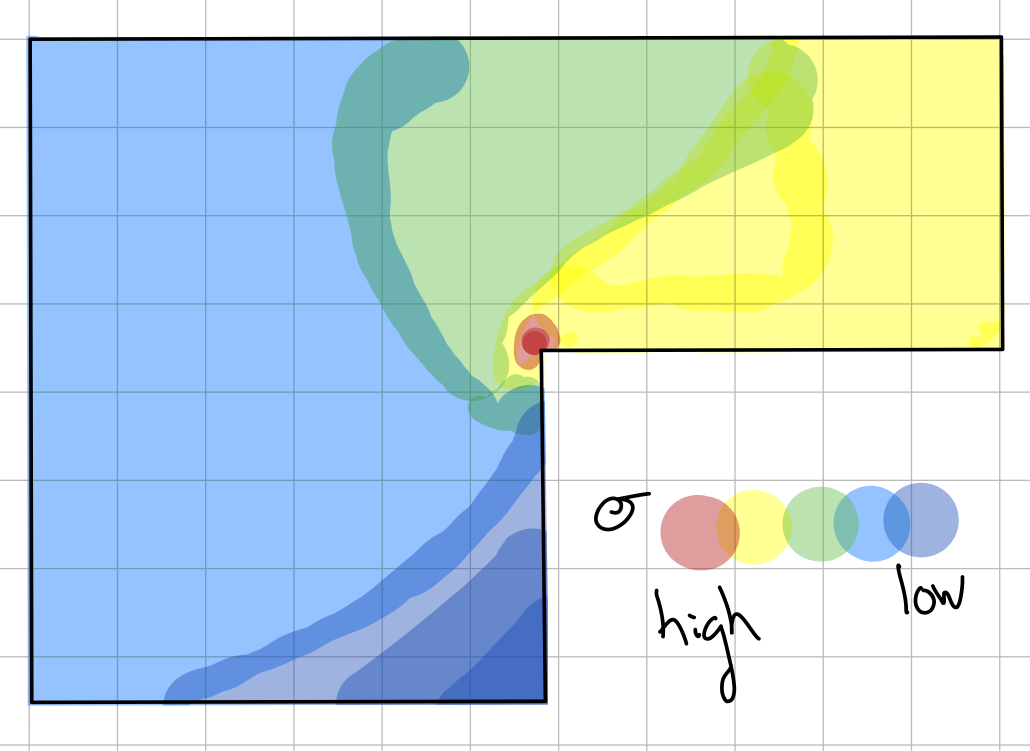
The stress concentration factor is the highest at lowest cross-sectional area.
- Found experimentally
- Solely based on geometry
Force-Deformation Relation
Interactive Visualization
The following interactive visualization allows you to explore how changing the applied axial force affects the normal strain and elongation. Left: axial strain. Right: axial displacement. Move the slider to change the force in both views.
Material: \( E = 2 \text{ GPa}, \ \nu = 0.25 \). Geometry: \( L = 2 \text{ m} \), width = 0.24 m, height = 0.32 m, \( A = 0.0768 \text{ m}^2 \). Formulas: \( u = \frac{Fx}{EA}, \ \varepsilon = \frac{F}{EA} \).
Drag to rotate · scroll to zoom · move the slider to change the force. Orange arrow = applied load direction. Dashed gray = original position. Color and reported values are physical; the displayed motion is magnified.
Axially Varying Properties
For non-uniform load, material property and cross-section area:General Solving Procedure
- Draw a FBD
- Equilibrium equations: force balance and moment balance
- Constitutive equations: stress-strain or force-displacement relations
- Compatibility equations: geometric constraints
Statically Determinate Problems
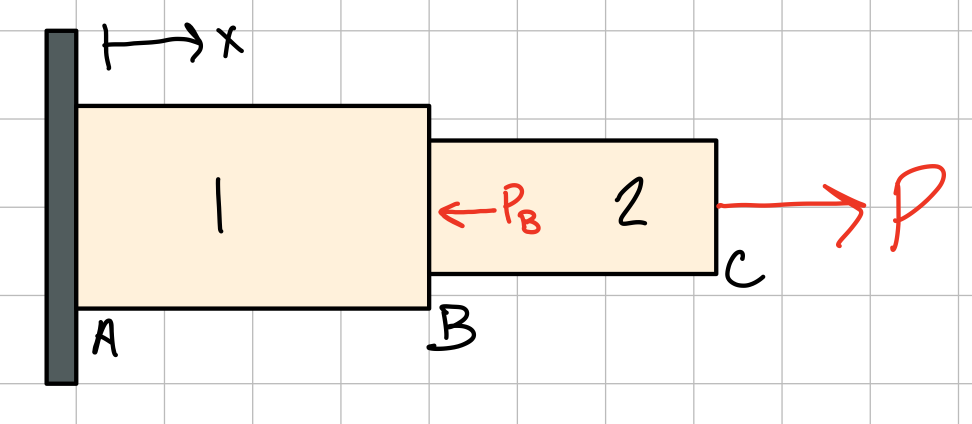
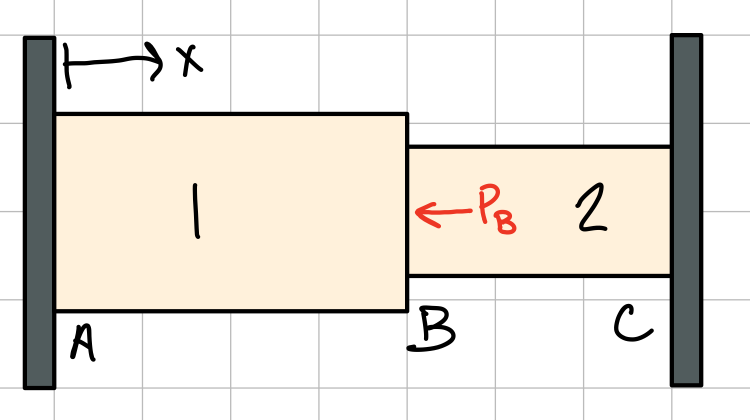
Statically Indeterminate Problems