Geometric Properties
Cross Sectional Area
Cross sectional area is the area of the face created by slicing through an object or geometry. The dimensions are \( length^2 \), with some common units being \( mm^2 \) or \( in^2 \).First Moment of Area: Centroid of an Area
The first moment of the area A with respect to the z-axis is given by \( Q_x = \int_A y dA = \Sigma yA \) . The first moment of the area A with respect to the y-axis is given by \( Q_y = \int_A x dA = \Sigma zA \). \( (\overline{x}, \overline{y}) \)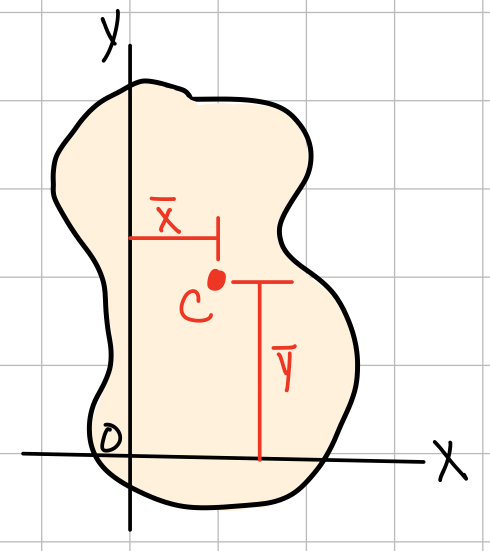
Centroid of a body
x coordinate.
y coordinate.
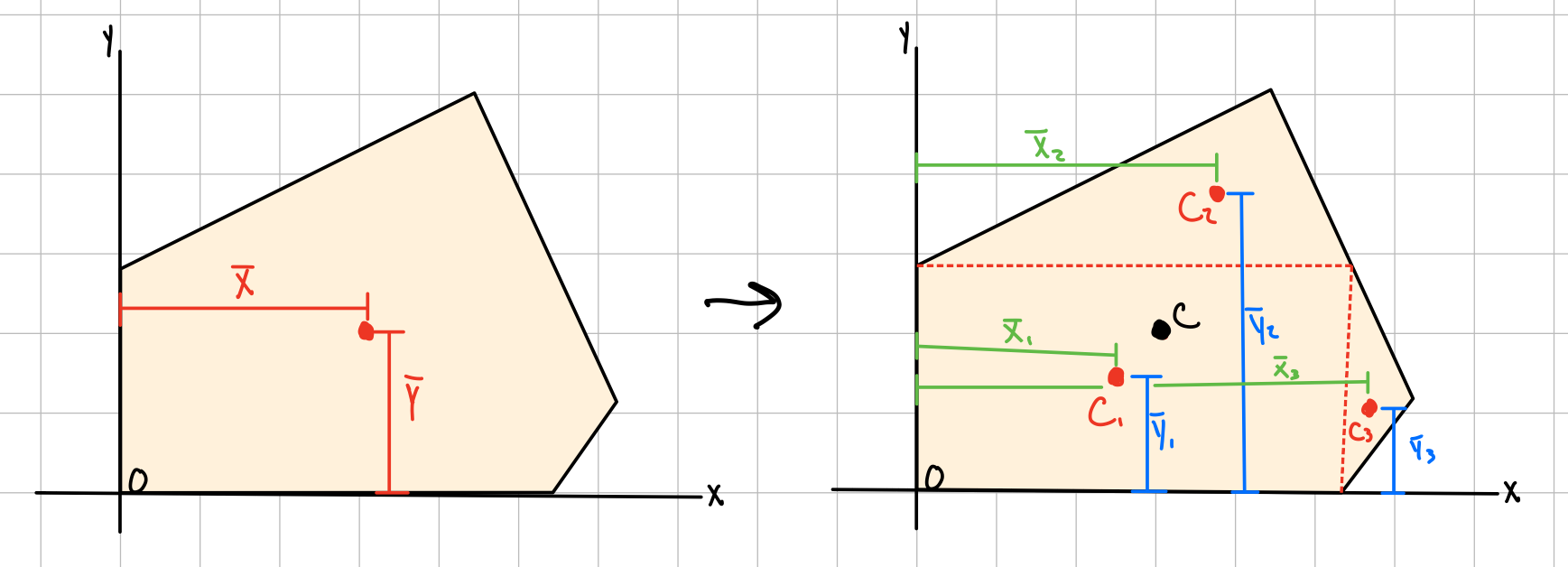
Centroid of a composite body
Composite x coordinate
Composite y coordinate
Second Moment or Area Moment of Inertia
The moment of inertia of the area \( A \) with respect to the x-axis. x-axis second moment.
y-axis second moment.
Note: polar moment of inertia in this plane
Polar moment of Inertia.
Parallel axis theorem.
Moment of Inertia of Simple Shapes
| Shape | Diagram | MoI about the centroid (centroidal axis) | MoI about the origin |
|---|---|---|---|
| Rectangle | 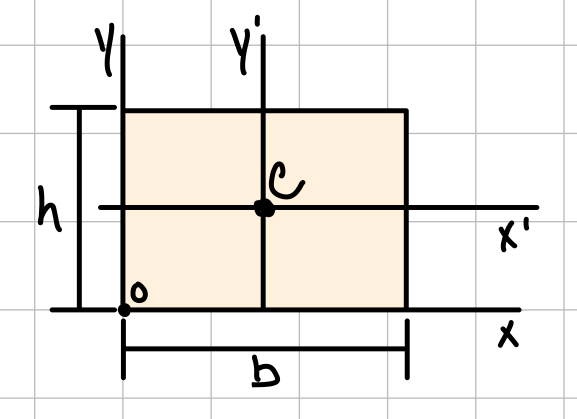 | \( I_{x'} = \frac{1}{12}b h^3 \) \( I_{y'} = \frac{1}{12}b^3 h \) \( J_c = \frac{1}{12}bh(b^2+h^2) \) | \( I_x = \frac{1}{3}b h^3 \) \( I_y = \frac{1}{3}b^3 h \) |
| Triangle | 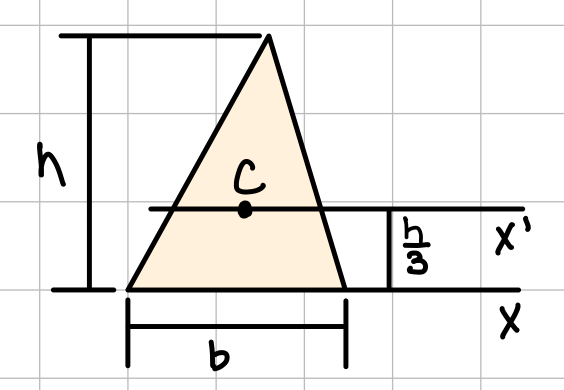 | \( I_{x'} = \frac{1}{36}bh^3 \) | \( I_x = \frac{1}{12}bh^3 \) |
| Circle | 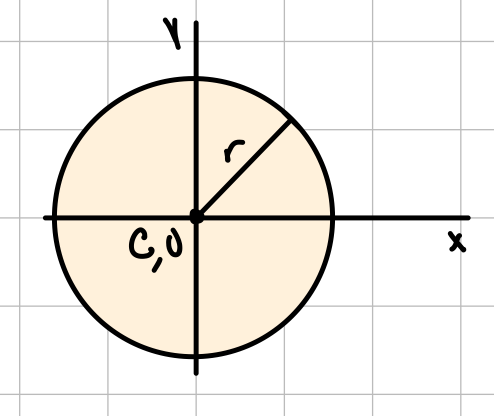 | \( I_{x'} = I_{y'} = \frac{1}{4} \pi r^4 \) | \( J_O= \frac{1}{2} \pi r^4 \) |
| Semicircle | 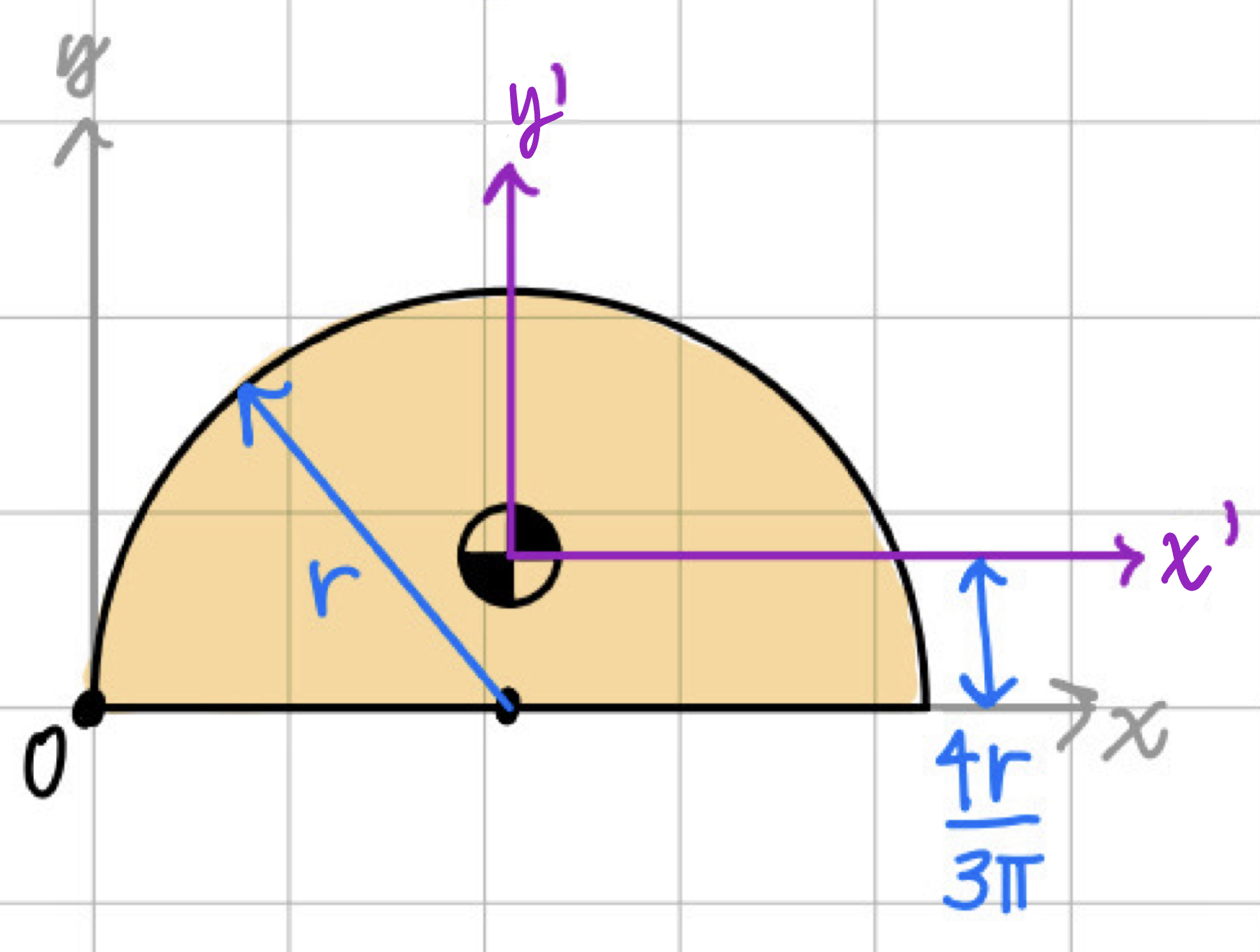 | \( I_{x'} = (\frac{\pi}{8} - \frac{8}{9\pi}) r^4 \) \( I_{y'} = \frac{\pi}{8}r^4 \) | \( I_x = I_y = \frac{1}{8} \pi r^4 \) \( J_O = \frac{1}{4} \pi r^4 \) |
| Quarter circle | 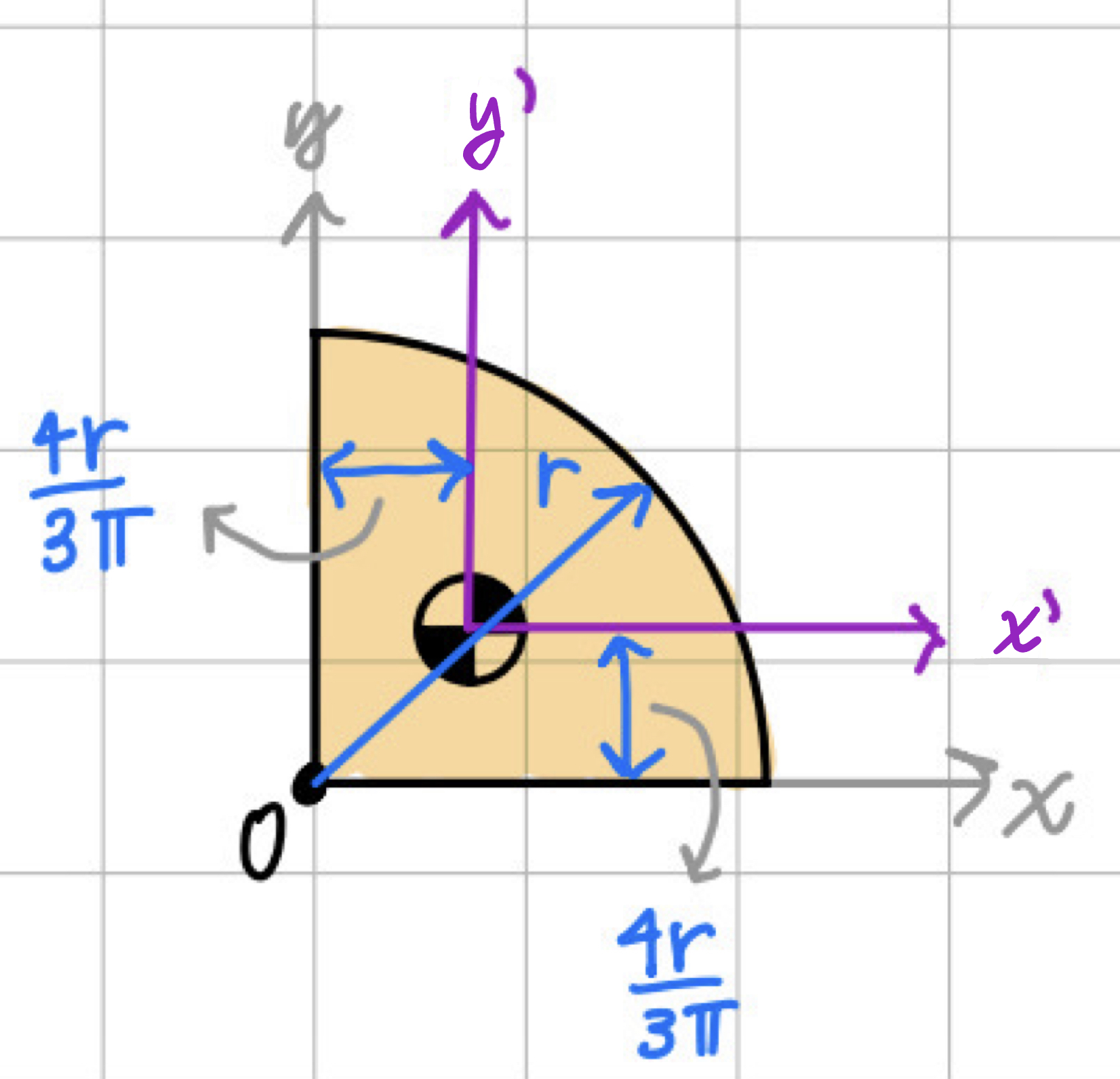 | \( I_{x'} = I_{y'} = \frac{1}{2}(\frac{\pi}{8} - \frac{8}{9\pi}) r^4 \) | \( I_x = I_y = \frac{1}{16} \pi r^4 \) \( J_O = \frac{1}{8} \pi r^4 \) |
| Ellipse | 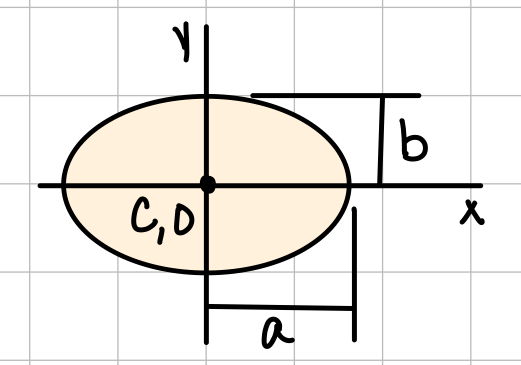 | \( I_{x'} = \frac{1}{4} \pi a b^3 \) \( I_{y'} = \frac{1}{4} \pi a^3 b \) | \( J_O = \frac{1}{4} \pi ab(a^2+b^2) \) |
Summary: Moment of Inertia
| Mass moment of inertia | Area moment of inertia | |||||||||||||||||||||||||||||||||
|---|---|---|---|---|---|---|---|---|---|---|---|---|---|---|---|---|---|---|---|---|---|---|---|---|---|---|---|---|---|---|---|---|---|---|
| Mass moment of inertia | Area moment of inertia (used in solid mechanics!) | |||
|---|---|---|---|---|
| Other names | First moment of area | Second moment of area | Polar moment of area | |
| Description | Determines the torque needed to produce a desired angular rotation about an axis of rotation (resistance to rotation) | Determines the centroid of an area | Determines the moment needed to produce a desired curvature about an axis(resistance to bending) | Determines the torque needed to produce a desired twist a shaft or beam(resistance to torsion) |
| Equations | | | | |
| Units | \( \mathrm{mass} \ \mathrm{length} ^ 2 \) | \( \mathrm{length} ^ 3 \) | \( \mathrm{length} ^ 4 \) | \( \mathrm{length} ^ 4 \) |
| Typical Equations | | | | |
| Courses | Dynamics | Solid mechanics | Statics, solid mechanics | Solid mechanics |
Review?
Need a review of moment of inertia (second moment of area)?
This content has also been in statics.
The second moment of area determines the moment needed to produce a desired curvature about an axis (resistance to bending).